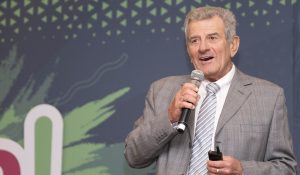
At the recent So-Ja! Soya Celebration, South Africa’s go-to economic analyst, Dr Azar Jammine, delivered a rare moment of optimism in a country that has become all too used to negative news. With over four decades at the helm of Econometrix, South Africa’s leading independent economic research consultancy, Dr Jammine offered an informed perspective on how soya is emerging as a beacon of growth in an otherwise underperforming economy.
“Graphs relating to soya production contrast in the gradient of growth with so many of the other dismal charts relating to domestic economic growth,” he remarked. This growth, he argued, is not merely statistical but emblematic of an industry seizing opportunities through innovation and resilience.
Over the past decade or more, South Africa’s economy has faced significant headwinds, from logistical bottlenecks and municipal dysfunction to persistent legacies of apartheid such as poor education outcomes and spatial inequalities. Despite recent positives, such as the cessation of load-shedding, the formation of the Government of National Unity (GNU), and a commitment to fiscal rectitude, Dr Jammine cautioned that achieving sustainable growth of 5-7% remains elusive. Structural challenges, including inadequate small business activity and an education system ill-equipped for a technologically intensive world, continue to hinder progress.
Against this backdrop, the soya industry’s dynamism offers a refreshing counterpoint. Dr Jammine emphasised its potential to drive economic diversification and sustainability. “It was exciting to be exposed to an industry that reflects on huge possibilities and opportunities to introduce innovative products to ensure a sustainable future,” he wrote, referring to soya’s versatility, spanning food, animal feed, and industrial applications. This positions it as a key player in addressing both domestic needs and export potential.
The symposium also underscored the industry’s human capital as a critical driver of its success. Dr Jammine was struck by the “enterprising and down-to-earth” nature of the participants, whose warmth and dedication left a lasting impression. “It was easy to recognise why the Soya industry is succeeding when it is being run by such people,” he noted, suggesting that the sector’s collaborative spirit is a model for other industries.
However, Dr Jammine also cautioned the attendees of soya’s rise within global uncertainties, particularly the potential impact of U.S. trade policies under a Trump administration. While South Africa faces a 10% blanket tariff affecting sectors like motor vehicles and wine, key agricultural commodities, including soya, may actually benefit from shifting trade dynamics with other markets.
“The bigger concern,” he explained, “is not necessarily the direct tariff impact, but the damage to global growth and investor confidence.”
Dr Jammine concluded with cautious optimism, urging the soya industry to maintain its momentum. “I wish the industry all the energy to proceed from one success to another in the future.”
As South Africa grapples with complex economic challenges, the soya industry offers more than just potential – it’s already growing with intent. For Dr Jammine, it’s a rare example of what’s still possible, and a sector worth watching.