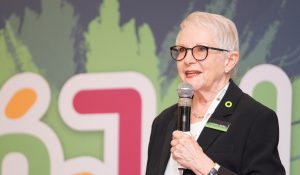
Lorraine Jenks arrived at the So-Ja! Soya Celebration with decades of insight into climate action and ESG policy, along with a personal connection to the soybean that predates most conversations about sustainability. In the 1970s, she was involved in the launch of Pronutro, one of South Africa’s first major soy-based products, which marked “the start of soy’s journey in the country.”
Her talk, Kudos to the Humble Soybean: The Unsung ESG Hero, connected her experience with the present-day urgency of climate change. “Why all this urgency about climate change, and ecocide?” she asked, before referencing the stark international benchmarks now shaping global policy.
According to the IPCC, we need to halve CO₂ emissions by 2030 and reach net zero by 2050. The Paris Agreement sets a limit of 2.0 degrees Celsius of warming above pre-industrial levels, with a strong preference for stopping at 1.5 degrees. The COP16 Biodiversity Framework calls for the restoration of 30% of degraded ecosystems and the conservation of 30% of land and marine areas by 2030.
These are lofty goals, but who’s actually doing something about them?
Jenks, who worked in sustainability long before it became fashionable, highlighted how the local soya sector, particularly the Pretoria Protein Company, is stepping up with practical sustainability models. Through a zero-waste approach, soybean meal becomes livestock feed, hulls become fibre for ruminants, and the oil supports food production, industry and biofuel. The company’s crushing facility is energy-neutral, operating with less coal, fewer emissions and greater efficiency by using compressed natural gas and combined heat and power.
Yet, despite its versatility, soya has often struggled in the court of public opinion. The taste and nutritional profile of meat alternatives still raises eyebrows, and many consumers don’t realise how vital soya is to the animal feed industry, let alone its role in products such as paint, adhesives, pharmaceuticals, and biodiesel. However, that perception is changing. The local industry is working hard to convey a more comprehensive narrative, one that encompasses both environmental benefits and economic resilience.
As Jenks moved through the many products soya can become, from alternative proteins to plant-based inks, she reminded the audience that innovation isn’t new in South Africa. “Back in the ’70s, South African Breweries was already working with soya protein,” she said. “We’ve had the tools. We just haven’t always used them effectively or wisely.”
For Jenks, the challenge is clearer than ever. Climate change, resource scarcity, and social inequality cannot be addressed with mere platitudes. They demand regenerative systems, circular economies, and ESG principles at every stage of the supply chain. And she believes the soya industry is already making significant progress.
It was a talk that struck a balance between urgency and possibility. And it stood comfortably alongside presentations by Dr Azar Jammine and Minister John Steenhuisen, whose talks focused on the economics and politics of agricultural transformation.
Jenks’s core message was simple: nothing wasted, everything utilised. It’s not about grand gestures, she suggested, but about the everyday choices that shape a better future for agriculture and the planet. “Every part of the soybean serves a purpose,” she said. “That’s the kind of thinking we need more of.”